The Citron of Calabria: History, Jewish Tradition, Cultivation and Uses
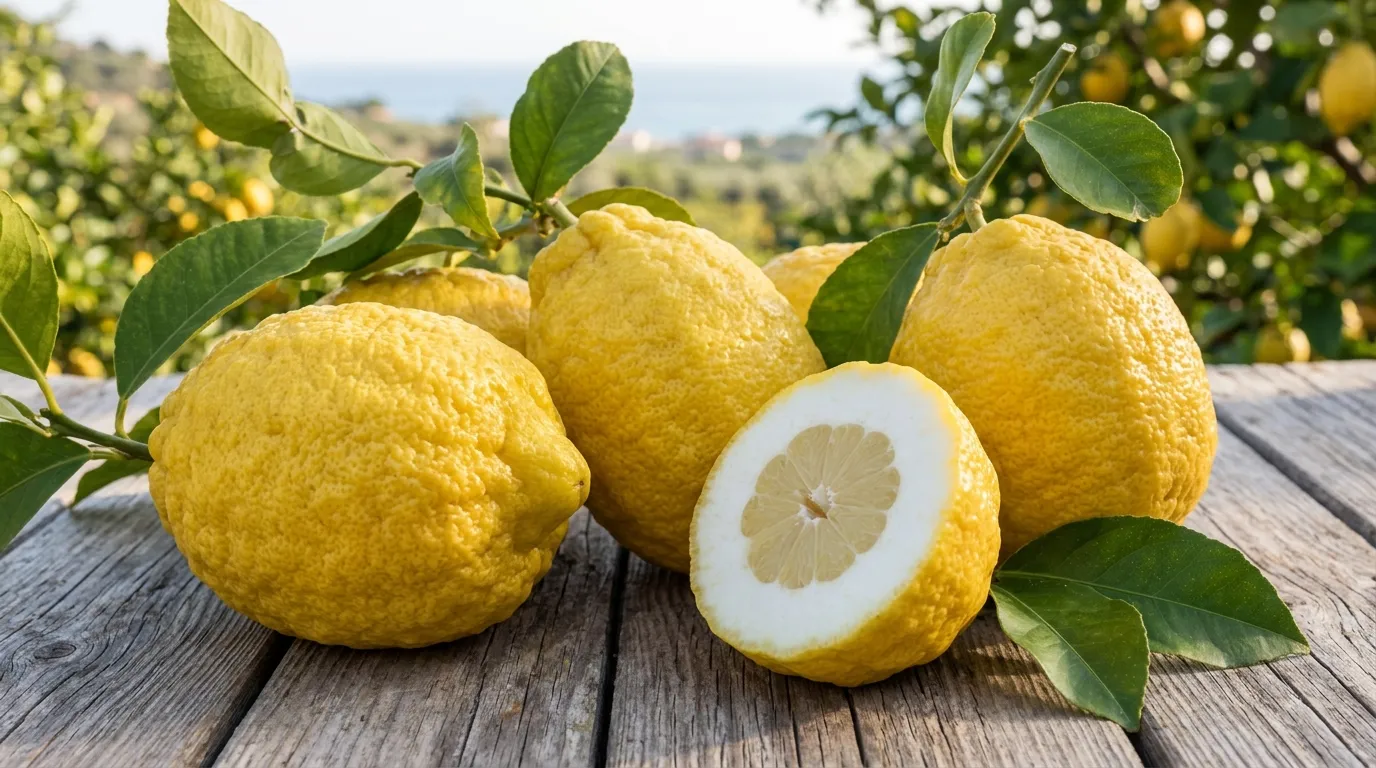
The citron of Calabria, known in Italian as cedro, is one of the oldest cultivated citrus fruits in the Mediterranean. With its thick aromatic peel, impressive size, and long history, this unusual citrus has a cultural importance that goes far beyond the kitchen.
In Calabria, particularly along the Riviera dei Cedri, the citron has become closely associated with the landscape, traditions, agriculture, and history of the region. The town of Santa Maria del Cedro, in the province of Cosenza, is especially well known for its cultivation.
The citron also has an important connection with Jewish tradition. A particular type of citron, known as etrog, is used during Sukkot, the Jewish Festival of Tabernacles. Treccani describes the etrog as a variety of Citrus medica traditionally used during this religious celebration.
Today, Calabria remains one of the best-known European regions associated with citron cultivation, while the Riviera dei Cedri continues to preserve the agricultural traditions surrounding this remarkable fruit.
What Is Citron?
Citron is the fruit of Citrus medica, a species belonging to the Rutaceae family. It should not be confused with the common lemon or lime.
The citron is generally much larger than a lemon and has a remarkably thick peel. Depending on the variety, the fruit can be oval, elongated, or somewhat rounded, with a yellow or greenish-yellow exterior.
Unlike many other citrus fruits, citron contains relatively little juicy pulp. Its thick aromatic rind is the part most valued for culinary and traditional uses.
Citron is considered one of the ancient citrus species from which later citrus diversity developed. Historical botanical sources place its early history in Asia, from where it eventually spread toward the Mediterranean.
Its ancient history is reflected in the names it acquired over centuries. Classical writers associated the fruit with Persia and Media, while the Romans knew it as citrus or malum citreum.
Citron and Jewish Tradition
One of the most fascinating aspects of citron is its connection with Jewish culture.
During Sukkot, the Festival of Tabernacles, Jewish communities use four species of plants in a traditional ritual. One of them is the etrog, a citron selected according to specific religious and physical requirements.
The etrog is therefore much more than an ordinary citrus fruit. Its appearance, aroma, shape, and condition can be particularly important when it is selected for religious use.
This tradition has helped maintain a strong historical connection between citron-growing regions of the Mediterranean and Jewish communities around the world.
The association is also reflected in the Italian word etrog, which comes from the Hebrew etrōg. Treccani specifically identifies it as a variety of citron traditionally used for the Festival of Tabernacles.
The Citron and the Story of the Garden of Eden
Citron has also been connected with interpretations of the biblical story of the Garden of Eden.
An old tradition proposes that the mysterious fruit eaten by Adam and Eve may have been a citron or another citrus-like fruit rather than an apple. This idea, however, belongs to religious and historical interpretation rather than established botanical or biblical fact.
The association developed partly because the ancient Greek word mêlon could be used more broadly for certain fruits rather than referring exclusively to the modern apple.
For this reason, citron has sometimes been included in discussions about possible interpretations of the fruit of the Tree of Knowledge.
It is important to distinguish these traditions from historical certainty. There is no definitive botanical identification of the biblical fruit.
From Ancient Persia to the Mediterranean
Citron has one of the longest histories among cultivated citrus fruits.
Ancient botanical literature connects the fruit with regions east of the Mediterranean, particularly Persia and neighboring parts of Asia. Classical Greek and Roman writers were already familiar with citron centuries before lemons, sweet oranges, and mandarins became widespread in the Mediterranean.
Treccani notes that the ancient Mediterranean world knew the citron before several other familiar citrus fruits arrived. Lemon and bitter orange appeared later, while sweet orange and mandarin were introduced much later still.
Over time, citron travelled westward and became established in parts of the Mediterranean basin.
Its journey eventually brought it to southern Italy, where Calabria developed a particularly important tradition of citron cultivation.
The Riviera dei Cedri in Calabria
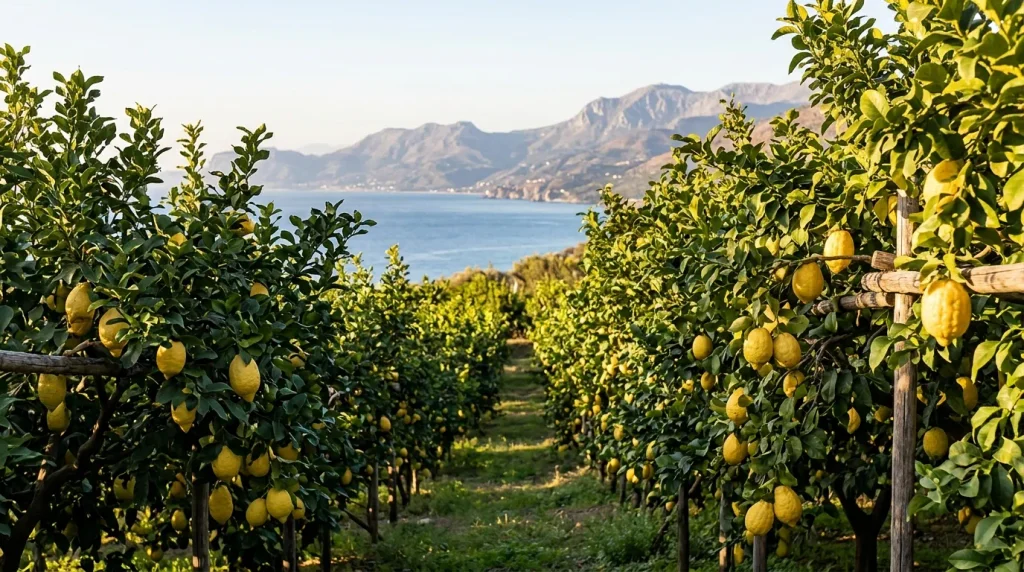
The citron of Calabria is closely associated with the Riviera dei Cedri, the stretch of Calabrian Tyrrhenian coast where citron cultivation became an important part of local agriculture.
The area includes communities in the northern part of Calabria, including Santa Maria del Cedro.
The region’s combination of coastal conditions, surrounding mountains, and agricultural soils creates a favorable environment for growing citrus. Historical sources also identify the northern Tyrrhenian coast of Calabria as an important area for citron cultivation.
The landscape is particularly distinctive because citrus orchards grow close to the sea while mountains rise nearby.
This combination has helped shape the agricultural identity of the area and contributed to the name Riviera dei Cedri, or Riviera of the Citrons.
Santa Maria del Cedro
Among the towns associated with the citron of Calabria, Santa Maria del Cedro holds a special place.
The town takes its modern identity from the fruit that has long been cultivated in the surrounding area. Citron is not simply an agricultural product here; it is part of the local cultural heritage.
Farmers have traditionally devoted considerable attention to the plants because citron cultivation is labor-intensive. The fruit and trees require careful management, and many operations have historically been performed manually.
The result is a traditional cultivation of citron of Calabria that has survived through generations.
The Diamante Citron of Calabria
Among the varieties associated with the citron of Calabria, the Diamante citron is particularly famous.
The name is associated with the town of Diamante, another important location along the Riviera dei Cedri.
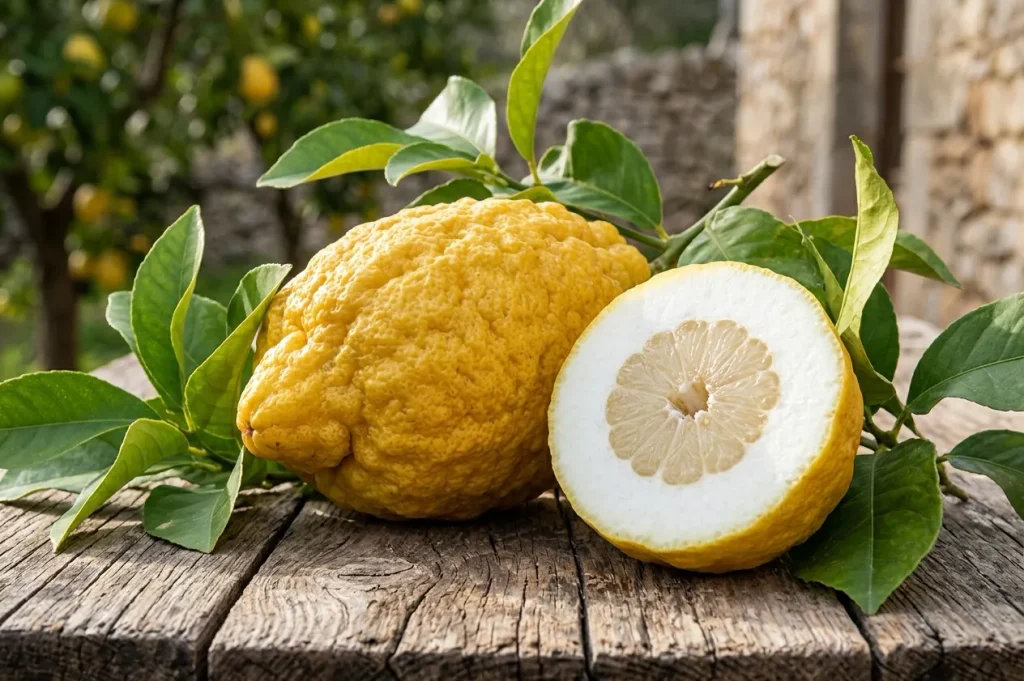
The fruit is known for its large size and thick, aromatic peel. Its appearance can be striking, especially when the fruit reaches maturity and develops its characteristic yellow color.
The thick rind is particularly valuable because citron is widely used for candied peel, preserves, syrups, liqueurs, desserts, and flavoring.
Rather than being treated like a typical juicy citrus fruit, citron is often valued for the aromatic qualities of its peel.
What Does Citron Taste Like?
Fresh citron has a very different character from a lemon.
Its peel is intensely fragrant and contains aromatic oils that give the fruit its distinctive citrus perfume. The white inner layer is exceptionally thick and can have a mild, slightly bitter character.
Because of its unusual structure, citron is more commonly processed before being eaten.
Candied citron is one of the best-known preparations. The thick rind is slowly preserved in sugar, producing a tender, fragrant ingredient used in pastries, cakes, panettone, confectionery, and traditional desserts.
Citron can also be transformed into:
- Candied citron peel
- Citron jam
- Syrups
- Citrus preserves
- Liqueurs
- Flavored beverages
- Desserts and ice cream
- Granita
- Confectionery
- Aromatic ingredients for baking
Citron of Calabria in Italian Cuisine
The culinary history of citron goes back many centuries.
The intensely fragrant peel of citron of Calabria makes it particularly useful in pastry and confectionery, where small amounts can provide a distinctive citrus aroma.
Candied citron is especially important in Italian baking. It can be incorporated into cakes, sweet breads, cookies, pastries, and other desserts.
Citron is also used in regional specialties of Calabria and other parts of southern Italy.
Because the peel is so thick, it can be preserved and transformed in ways that would not be practical with many other citrus fruits.
Its flavor works particularly well with ingredients such as:
- Almonds
- Chocolate
- Ricotta
- Vanilla
- Honey
- Dried fruit
- Nuts
- Other citrus fruits
Traditional Calabrian Citron Products
The relationship between citron and Calabrian food culture extends beyond candied peel.
Local producers have developed a variety of products based on the fruit, including preserves, syrups, liqueurs, flavored oils, sweets, and beverages.
One traditional preparation associated with the area is Panicelli, small bundles traditionally made using citron leaves and dried grapes, with candied citron incorporated into the mixture.
Citron has also been used to flavor ice cream and granita, while citron-based drinks have long been part of Italian beverage culture.
One familiar example is cedrata, a sweet sparkling citron beverage that became particularly popular in Italy during the twentieth century.
Citron in Perfume and Cosmetics
Citron is valued not only for food.
The strongly aromatic peel contains essential oils that have applications in fragrance and flavoring.
The distinctive citrus scent has made citron attractive to the perfume industry, where its fresh, bright aroma can be incorporated into fragrances and other scented products.
This gives the fruit another life beyond agriculture and gastronomy.
Citron Cultivation Is Labor Intensive
Growing citron is not necessarily an easy agricultural process.
The plants are sensitive to environmental conditions and require careful attention throughout the growing season.
Citron orchards traditionally depend heavily on manual labor. Farmers must monitor the plants, manage the soil, protect the fruit, and harvest carefully.
This hands-on approach is particularly important when fruit is intended for premium culinary or religious purposes.
The value of the crop therefore depends not only on the fruit itself but also on the knowledge and experience of the growers who maintain the orchards.
The Citron Museum in Santa Maria del Cedro
The cultural history of citron is preserved in Santa Maria del Cedro, where the local citron museum documents the relationship between the fruit, the territory, agriculture, and Jewish tradition.
A museum dedicated to citron helps demonstrate how one agricultural product can become part of the identity of an entire region.
The story extends beyond farming. It includes ancient history, religious traditions, Mediterranean trade, local food culture, and the development of modern citron production.
For visitors interested in food history, Calabria, or Mediterranean agriculture, the citron heritage of Santa Maria del Cedro offers an unusual perspective on the region.
Why the Citron of Calabria Matters
Citron of Calabria is easy to overlook because it is less familiar than oranges, lemons, and mandarins.
Yet its history is remarkable.
It is one of the ancient citrus fruits, has a significant place in Jewish tradition through the etrog, and has been cultivated around the Mediterranean for centuries. In Calabria, it has also become closely connected with the identity of an entire coastal region.
The Riviera dei Cedri demonstrates how a single fruit can influence local agriculture, food traditions, tourism, and cultural heritage.
From the orchards of Santa Maria del Cedro to traditional Italian pastries and the ritual use of etrog during Sukkot, citron continues to connect ancient traditions with modern life.
Final Thoughts
The citron of Calabria is much more than an unusual citrus fruit.
Its thick fragrant peel, ancient history, religious significance, and role in Calabrian cuisine make it one of the most fascinating citrus fruits in the Mediterranean.
Whether transformed into candied peel, used in traditional desserts, distilled into a liqueur, or carefully selected as an etrog for Sukkot, citron carries centuries of history in a single fruit.
For Calabria, particularly the Riviera dei Cedri, that history is still alive in the orchards, kitchens, festivals, and traditions of the region.
The next time you see citron of Calabria, remember that you are looking at one of the oldest members of the citrus family—a fruit whose story reaches from ancient Asia to the Mediterranean and from traditional agriculture to modern Italian cuisine.
You May Also Like
Carrot Gnocchi Recipe with Mushrooms and Sage